Ol Pejeta
Rhinos
Discover Kenya's remarkable rhino
conservation story and the landscapes
protecting these ancient giants.
Ol Pejeta Conservancy, located in Laikipia County near Nanyuki, is one of Kenya’s most important wildlife conservation areas and one of Africa’s major strongholds for rhinoceroses. The conservancy covers approximately 90,000 acres of grasslands, woodlands and wildlife habitat and supports populations of eastern black rhinos and southern white rhinos. It is also internationally known as the home of Najin and Fatu, the last two northern white rhinos in the world. Ol Pejeta combines wildlife protection with scientific research, habitat management, veterinary care, tourism and community development, making it an important centre for modern conservation.
A major stronghold for black rhinos
Ol Pejeta has achieved remarkable success in the conservation of the eastern black rhinoceros (Diceros bicornis michaeli), a Critically Endangered subspecies. Kenya's black rhino population suffered a catastrophic decline during the 1970s and 1980s as poaching for rhino horn reached devastating levels. From a national population of almost 20,000 black rhinos in the 1970s, numbers fell to fewer than 400 by the mid-1980s. Stronger protection and conservation programmes subsequently allowed Kenya's population to recover.
Ol Pejeta has been an important part of that recovery. The conservancy reported 183 black rhinos in 2025, including 17 calves born during the year. This makes it one of the most significant black rhino populations under protection in the region. The growing population is itself creating a new conservation challenge because suitable habitat is limited. Ol Pejeta is therefore involved in efforts to expand rhino populations into other suitable areas rather than allowing increasing numbers to become concentrated in a few protected locations.
The conservancy's approach is not based s on allowing rhinos to reproduce. Conservation teams monitor individual animals, maintain detailed population records, provide veterinary intervention when necessary and manage the habitat on which the animals depend. These measures help maintain a healthy population while providing information that can guide rhino conservation elsewhere in Kenya.
Southern white rhinos
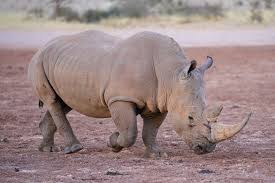
Ol Pejeta also supports a population of southern white rhinos, another subspecies of white rhinoceros. Unlike the northern white rhino, the southern white rhino has experienced a substantial conservation recovery after suffering severe historical declines.
The presence of both black and white rhinos at Ol Pejeta makes the conservancy particularly valuable for rhino conservation and education. Visitors can observe differences in their body shape, feeding behaviour and preferred habitats while learning about the different conservation challenges facing the two species.
The last two northern white rhinos
The most extraordinary part of Ol Pejeta's rhino story is the survival of Najin and Fatu, the world's last two northern white rhinos (Ceratotherium simum cottoni).
The northern white rhino once occupied parts of Uganda, Chad, Sudan, the Central African Republic and the Democratic Republic of the Congo. Decades of poaching, habitat destruction and prolonged civil conflict devastated the subspecies. Eventually, it disappeared from the wild.
Najin and Fatu are both female. Their inability to reproduce naturally means that the future of the subspecies depends on reproductive technology. Their situation illustrates how wildlife populations can reach a point where traditional conservation methods alone are no longer sufficient.
Najin and Fatu arrived at Ol Pejeta in 2009, together with two other northern white rhinos, from Dvůr Králové Zoo in the Czech Republic. Conservationists initially hoped that a natural environment might encourage reproduction. However, scientific investigations later established that natural reproduction was not a realistic solution.
The attempt to save the northern white rhino through science
An international scientific programme known as BioRescue was developed to address the reproductive crisis. The project combines reproductive medicine, embryology, genetics and conservation science.
Scientists have collected eggs from Fatu and used preserved sperm from deceased northern white rhino males to produce northern white rhino embryos in laboratories. The embryos are frozen and carefully preserved while researchers work toward the next stage: transferring them into suitable southern white rhino surrogate mothers.
By April 2026, the programme had produced 39 pure northern white rhino embryos. This is an important scientific milestone, although it should not be confused with a successful birth. The ultimate objective is to achieve a healthy pregnancy and eventually produce a northern white rhino calf.
The programme has already progressed to embryo-transfer attempts. During 2025, scientists transferred northern white rhino embryos into southern white rhino surrogate mothers at Ol Pejeta. The attempts did not result in long-term pregnancies, but they provided important information for improving future procedures. Because rhino IVF is a relatively new field, researchers are learning from each stage of the process.
Najin's retirement from the reproductive programme
There has also been an important development concerning Najin. After veterinary and ethical assessments, scientists decided that she should no longer undergo egg-collection procedures because of the risks associated with the procedure at her advanced age.
Fatu is therefore the only living northern white rhino currently providing eggs for the embryo programme. Najin remains under protection at Ol Pejeta and continues to have an important biological and conservation value.
Her retirement demonstrates an important principle in conservation. Protecting an endangered species also requires consideration of the welfare of individual animals. Scientific objectives cannot be separated from the health and wellbeing of the animals involved.
Intensive security and protection
The survival of rhinos at Ol Pejeta depends heavily on security. Rhino horn has historically made rhinoceroses targets for organised poaching networks, so protecting them requires continuous monitoring and highly trained conservation teams.
Ol Pejeta uses armed rangers, specialised security units, canine teams, intelligence operations, technology and regular patrols to protect its wildlife. Rangers work across the conservancy's extensive landscape, monitoring animals and responding to potential threats.
The conservancy reported that it had gone more than nine years without a rhino being poached by July 2026. This represents an important achievement given the historical threat posed by rhino poaching in Kenya and across Africa.
Individual rhinos are also closely monitored. Conservation teams can identify animals through features such as ear notches and other physical characteristics, while records are maintained on their movements, health, reproduction and family relationships. Such monitoring allows conservationists to understand population changes and respond when individual animals require assistance.
Baraka and the importance of individual rhino welfare
One of Ol Pejeta's best-known individual rhinos was Baraka, a black rhino born at the conservancy in 1994. His life demonstrated another dimension of conservation: sometimes protecting an endangered species means providing specialised care for individual animals that can no longer survive safely on their own.
Baraka lost one eye following a fight with another rhino and later became completely blind after developing cataracts in his remaining eye. Because his blindness made life in the wider conservancy extremely difficult, he was moved to a protected enclosure where conservation staff could provide food, veterinary care and protection.
Baraka died in August 2026 at the age of 31. His story became an important educational part of Ol Pejeta's conservation work, showing visitors that conservation is not only about population numbers. It is also about understanding individual animals and providing appropriate care when circumstances require it.
A growing population and a new challenge
The success of rhino conservation at Ol Pejeta has produced an unusual problem: there are now many more rhinos than there were several decades ago, but the available habitat is finite.
Ol Pejeta reported a total rhino population of 240 animals in 2025, following the birth of 25 calves during the year. Population growth is an important conservation achievement, but it also means that managers must carefully balance the number of rhinos with available food, water and habitat.
One response is to support the expansion of rhino populations into other suitable conservation areas. Moving animals can help establish new breeding populations while reducing pressure on existing habitats. Ol Pejeta has consequently become an important source of animals and expertise for wider rhino conservation efforts in Kenya.
Conservation beyond the rhinos
Ol Pejeta's work extends beyond protecting individual species. The conservancy operates a broader model that connects wildlife conservation, tourism, community development, agriculture, education and scientific research.
Tourism provides visitors with an opportunity to see wildlife while also learning about conservation. Revenue from the conservancy's activities supports conservation operations and programmes that benefit surrounding communities. This connection between wildlife and people is important because long-term conservation depends not only on protected habitats but also on relationships with neighbouring communities.
The conservancy's location in Laikipia also places it within a larger landscape containing numerous wildlife conservancies and ranches. Protecting wildlife across such interconnected landscapes can provide animals with greater opportunities to move between habitats and can contribute to the long-term resilience of wildlife populations.
A symbol of both hope and warning
The rhinos of Ol Pejeta tell two very different stories. The black rhino population represents recovery: a species once devastated by poaching can increase when protection, habitat management, breeding and long-term conservation are maintained.
The northern white rhinos represent the consequences of extinction. With only Najin and Fatu remaining, natural recovery is no longer possible. Their survival now depends on an extraordinary combination of traditional conservation and cutting-edge reproductive science.
Together, these stories make Ol Pejeta one of the most significant rhino conservation sites in Africa. It is a place where conservationists are protecting a growing population of black rhinos, safeguarding southern white rhinos and simultaneously attempting to prevent the complete disappearance of the northern white rhino.
Ultimately, Ol Pejeta is more than a sanctuary where visitors can see rhinos. It is a major centre for rhino protection, breeding, veterinary care, scientific research and conservation innovation. Its experience demonstrates both what can be achieved when endangered wildlife receives sustained protection and what can be lost when poaching and habitat destruction continue unchecked.
Discover Rhinos
 Gentle Giants